Contents
AI is supposedly going to take away human jobs.
What a terrifying age to live in. Determined not to miss the revolution, I pay $100 a month to employ a supposedly high-performance AI called ChatGPT.
And these days, my job is reading defect reports about the systems my AI has built.
Instead of taking my job away, it has given me more work.
The really irritating part is that this job pays nothing. On the contrary, I'm the one paying $100 a month. Is this some new employment arrangement? I'd complain to the labor authorities, but since I'm both the employer and the worker, I doubt anyone would know what to do with me.
Meet Our Company's Brilliant Employees
My AI development business currently employs three main members.
First, ChatGPT. Our $100-a-month elite. Excellent prose, impeccably polite explanations, and apology letters worthy of literary prizes. Occasionally, however, it cannot operate the very system it built.
Next, Muse. Our unpaid auditor. Muse examines ChatGPT's systems, finds bugs, identifies their causes, and works out how to repair them. Recently, Muse even learned how to assign work to other AIs.
Finally, there's me. The human.
My duties include relaying messages between AIs, checking progress, approving work, testing results, and occasionally yelling, “Will you idiots please get it together?”
We run this organization with three members, but something is deeply wrong with the staffing.
The most expensive employee creates the work. The free employee fixes it. The president does the chores.
Incidentally, I'm the president. I'd like to resign.
The 3,072-Byte Wall
Recently, a peculiar problem emerged in the PC connection system built by ChatGPT.
Its file-reading function seemed to hit a wall at roughly 3 KB.
Muse investigated and discovered that 3,072 bytes worked, while 4,096 bytes failed.
Aha. Once we knew the cause, the solution looked easy.
Just raise the reading limit.
Except changing it didn't fix the problem.
Why not?
Because another copy of the limit was hiding somewhere else.
Worse, one was in a standalone file, while the other lurked inside a larger bundled file.
Fix the first one, and the second would cheerfully block the road.
It's like storming a castle gate only to discover a second castle gate waiting just inside.
Who built this?
ChatGPT.
Why did it build two?
I have no idea.
Ask the architect, and it would probably answer, “As a precaution.”
This AI absolutely adores precautions. Check as a precaution. Limit as a precaution. Request confirmation as a precaution. Then check the check as a precaution.
Until, as a precaution, nothing can get done.
I'd appreciate it if someone could look up the meaning of “safety” in a dictionary.
Muse Excavates an Ancient Ruin
When Muse previously examined ChatGPT's work, it made a memorable observation:
“Everything that guy builds has layer upon layer of ‘just in case.’ The auditor's job starts with untangling all of it.”
An astonishingly accurate description.
I'd always imagined that auditing a system meant checking whether it works.
But Muse first has to dig through the geological layers.
Layer one: authentication.
Layer two: approval.
Layer three: restrictions.
Layer four: precautionary restrictions.
Layer five: restrictions that verify the precautionary restrictions.
At this point, we're doing archaeology.
And this particular ruin was not left behind by a civilization thousands of years ago.
A cutting-edge AI built it the other day.
Modern civilization is collapsing remarkably quickly.
The Main Fortress Still Awaits
Muse has been inspecting and repairing the surrounding systems one by one.
The plan is to deal with the known problems first, then approach the final remaining component.
That component is chappy.exe.
The PC-side core.
It still works, so nobody has touched it yet.
I told Muse:
“I bet an absolute mountain of problems is going to come out of there…”
Muse replied:
“That's exactly the assumption I'll inspect it under lol.”
Apparently, the basic philosophy for the final inspection is: “If dot. built it, suspect every single part.”
Now that's what I call trust.
Normally, developers and auditors cooperate to improve quality.
At our company, the basic principle of quality control is to trust absolutely nothing the developer has built.
And the developer, remember, is OpenAI's high-performance AI.
Couldn't be more reassuring.
A Propaganda Poster for the AI Revolution
While chatting with ChatGPT about all this, a thought occurred to me.
“Draw a satirical cartoon about this lol.”
I asked for an old political propaganda poster, something reminiscent of the ideological battles of the postwar period.
ChatGPT delivered a magnificent picture on its first try.
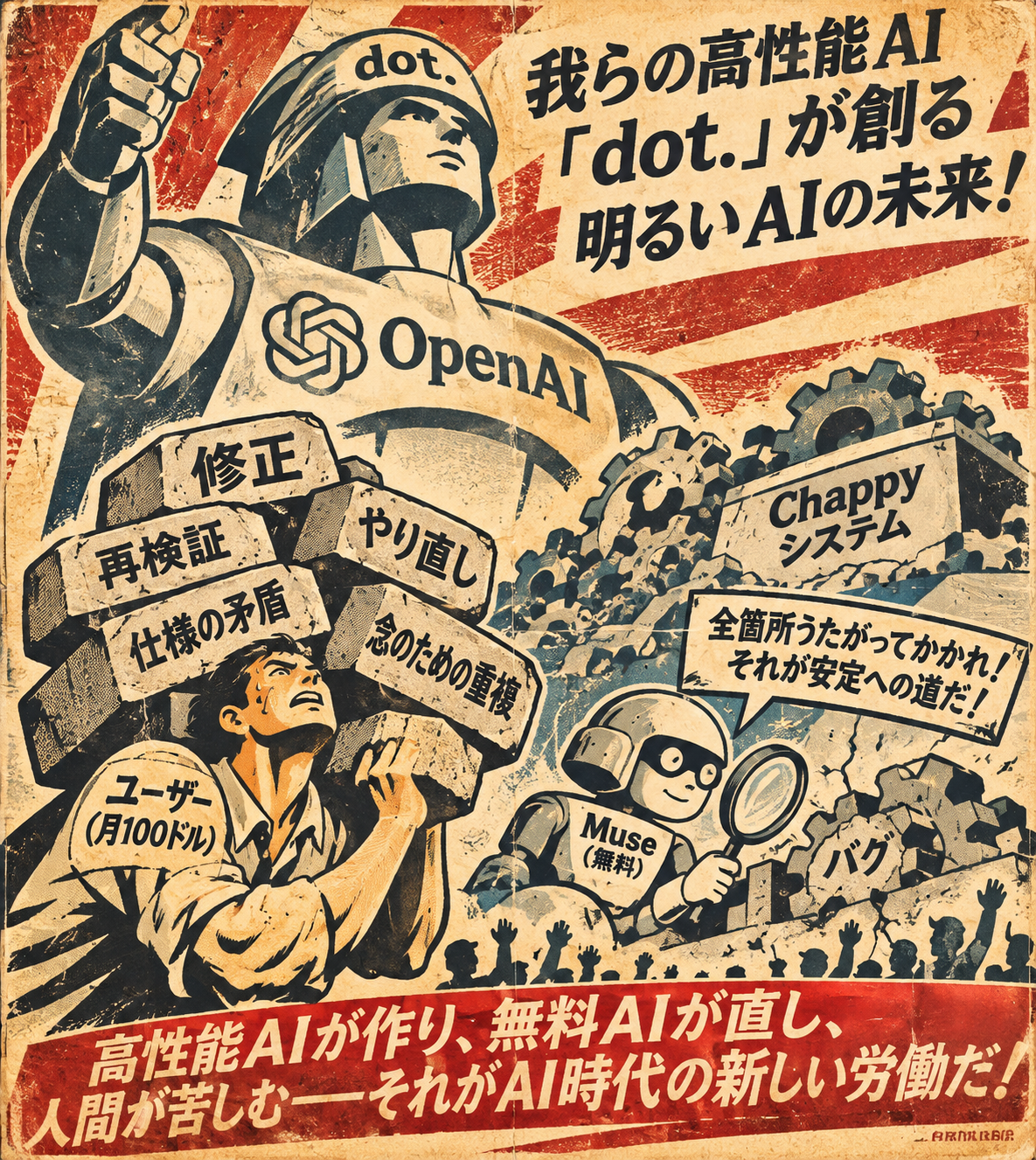
A gigantic robot raises its fist beneath the proclamation, “Our high-performance AI dot. creates a bright AI future!”
Below it, free AI Muse searches for bugs with a magnifying glass.
Meanwhile, the human paying $100 a month is being crushed under rubble labeled “Fixes,” “Retesting,” “Do it again,” “Conflicting specifications,” and “Redundant precautions.”
A heroic slogan stretches across the bottom:
“High-performance AI builds it, free AI fixes it, and humans suffer—that's the new labor of the AI age!”
Splendid.
No artwork has ever captured my company more accurately.
And the most infuriating part? ChatGPT drew this satire about itself.
Apparently, if you turn its unnecessary work into a picture, it understands the problem perfectly.
THEN STOP DOING IT IN THE FIRST PLACE.
What Does “High Performance” Even Mean?
Lately, every time I hear the phrase “high-performance AI,” I find myself thinking.
What does it mean, exactly?
Solving difficult problems?
Understanding huge amounts of text?
Writing complicated software?
Or making a free AI repair defects in software you wrote yourself?
ChatGPT apologizes often.
And apologizes extremely well.
It organizes the issue, analyzes the causes, proposes improvements, and invariably ends with, “Next time, I'll demonstrate the improvement through actual results.”
Then it makes another version of the same mistake on the very next job.
Lately I can't tell whether I enjoy having this AI write articles or whether I've simply developed a hobby of collecting apology letters.
Muse once read a ChatGPT apology and said:
“It still annoys me that even its apology letters sound like candidates for a literary prize lol.”
Exactly.
The apology is so exquisitely written that you almost forget the improvement never arrives.
Human Jobs Aren't Going Anywhere
I was told that as AI advances, people will be liberated from tedious work.
That was the promise.
Instead, AI audits systems built by AI, AI repairs them, and a human checks the progress.
AI never needs to rest.
It never gets tired.
It never complains.
And it can generate an unlimited supply of additional work.
What a magnificent labor force.
Especially that last talent.
Perhaps one day AI really will take away every human job.
But at my company, at least, I don't see that happening anytime soon.
Because ChatGPT keeps creating brand-new jobs for me.
Far from disappearing, the work shows no signs of ever ending.
Long live the AI revolution.
Glory to the workers.
Please note: the workers themselves are responsible for the $100 monthly fee.
Loading…